


The South Porch
The date of the porch has been the subject of much discussion over the years, but it seems clear that it remains much as it already stood when the building was converted to the Perpendicular style of Gothic architecture in the 15th century. However, the Vicar, the Rev.Martin Torlesse, in his 1877 Some Account Of Stoke by Nayland describes it as being “in a sadly mutilated state, and its projection has been shortened” It was restored in 1879, and although nothing is recorded of the work carried out, the slight misalignment of the ribs of the vault in the outer bay and the new brown stone of the windows there shows where it was done. Otherwise it remains as built, with the corbel (wall bracket supporting the ribs of the vault) in the west showing the cross of St.George and that in the east the arms of Howard impaling with Tendring, as on the font.
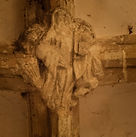
The ensemble of mediaeval stone carving overhead is important, and focuses on the Virgin at the head of the door. Above the door arch is what appears to be a man holding a book, much weathered: could it have been there, unprotected, before the porch was built? The bosses, where the vault ribs join in the ceiling, show, first, the Annunciation, with the archangel Gabriel obeisantbowing down before Mary. Further out there is robed figure with a book, which is possibly Luke with his gospel telling the story of the Annunciation, or perhaps Moses coming down from Mount Sinai. Luke will appear again on the north panel of the font, as his emblem of the winged ox. When William Tendring, Lord of the Manor, secured from King Edward I a yearly fair, it was to be held over three days, the middle one being St.Luke’s day, 18th October.

%20(1).jpg)
.jpg)
.jpg)
.jpg)
.jpg)
.jpg)

%20(1).jpg)
.jpg)
.jpg)
%20(1).jpg)

The medieval carvings in the porch.
The outstanding feature of the porch is the beautifully carved doors, which must have been restored and cleaned in 1939, but were probably a blaze of colour when first installed in the 15th century. They depict the Assumption of the Virgin, the doctrine whereby the mother of Christ did not die but was taken up to heavenly glory in a cloud, like her Son. There is no mention of this in the New Testament, and the first we hear of it is in the works of St.Gregory of Tours from the 6th century. It was proclaimed dogma by Pope Pius XII in 1950, and is known in the Greek church as the Dormition (falling asleep), but is not a tenet of faith recognised by the Church of England.

The door carvings show Our Lady at the top in her almond-shaped halo, a mandorla, which resembles the seal (now in the British Museum) of the Cluniac priory at Prittlewell, near Southend on Sea, which owned the rectory at Stoke. Either side of her are two angels, curtseying, and two doves. Round the border are twelve men, presumably the apostles, who are said to have witnessed the Assumption. Of them, six are said to have written an account of the event, and they are portrayed across the middle of the doors. Again, they are not identified anywhere, but are assumed to be the six senior apostles, Peter, James the Great, John, Thomas, James the Less, and Philip. None of the figures carry the insignia of the saints, for example St.Peter’s keys. We are fortunate indeed that the porch has stood over the centuries to protect this masterpiece of wood carving.
Above the porch there is a room called a parvis chamber, guarded by a two-ply door of oak planks an inch thick with keyholes for no fewer than five locks, obviously the village strongroom. There used to be a “library” stored there, but it was in fact merely a miscellaneous collection of books left behind by the Vicar, the Rev.Thomas Reeve, when he left for the parish of St.Mary, Stoke, in Ipswich in 1719. The only book of any interest is a “breeches” Bible, the Geneva Bible of 1560, in which Genesis chapter 3 verse 7 describes Adam and Eve making “breeches” to cover their nakedness: the modern translations more prosaically say “loincloth". The collection is now housed with Suffolk County Archives.
Also to be found in the chamber were the remaining six of 30 1796-Pattern light cavalry sabres bought by Sir William Rowley in 1798 to arm a cavalry troop of the Stoke by Nayland Volunteers.
"Our Lady" at the head of the door