

THE NAVE
_JPG.jpg)

_edited.jpg)


Examples of the carvings in both wood and stone
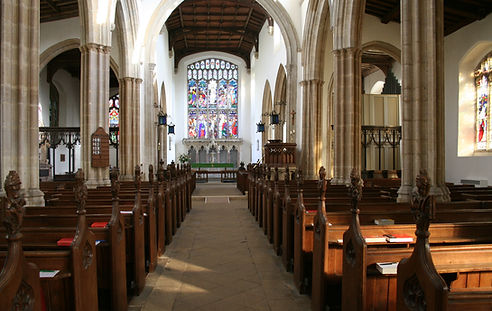
Standing by the font and looking east we see the impressive height and length of the nave and chancel, with their tall arcades and clerestory either side. The guildsman of the late Middle Ages processing in from the west door on holy days would have been even more impressed because there would have been no pews to clutter the sweep of the view. His first focus would be on the chancel arch, with a rood screen blazing with colour and gold, and above it a painting partly uncovered in 1865 when the plaster was removed: it has been suggested that it may have represented Christ and the twelve apostles with saints and angels. Pious Elizabethans had replaced the plaster and painted inscriptions of Revelations 1 vv. 7 and 8 - “Behold, he cometh with clouds; and every eye shall see him: and all kindreds of the earth shall wail because of him. Even so, Amen I am Alpha and Omega, the beginning and the ending, saith the Lord, which is, and which was, and which is to come, the Almighty.” and of II Corinthians 5 v.16 – “Wherefore henceforth know we no man after the flesh: yea, though we have known Christ after the flesh, yet now henceforth know we him no more.” These texts have in their turn sadly been plastered over.

.jpg)

The carved upper frieze
His second focus would have been on the altars at the chancel step dedicated to the guilds’ patrons (underlined)), identified from mediaeval wills – St.John the Baptist in the north aisle, St.James where the lectern now stands, St.Peter in the pulpit’s position, the Holy Trinity in the south aisle, and Our Lady, which was of course the dedication of the entire building. Had he cared to look up, he would have seen that the first four corbels of the roof on each side nearest the tower are curiously carved, and also, on the south side under the eighth corbel in the clerestory, two carved birds whose significance is unknown.


The first eight carved corbels at the west end
Today, by the chancel step, is the lectern, a replacement in 2009 for an oaken eagle stolen in 2001, which shows on the right side the Torlesse arms and on the left the Howard/Tendring blazon: and on the south side the pulpit of oak, Caen stone and Languedoc marble installed in 1865. The appearance of the church today is a product first of the dreadful damage wrought by “Colonel” William Dowsing, “Commissioner for the Destruction of Monuments of Idolatry and Superstition” on 19th January 1643 – “We brake down an 100 Superstitious Pictures (i.e. the stained glass) and took up 7 superstitious Inscriptions on the Grave Stones (i.e. the brasses), Ora pro Nobis.”, and second of the extensive remodelling undertaken in 1865. It is extremely interesting that Miss Frances Torlesse (1839-1935), the Rev.Martin’s youngest child, wrote in her memoirs BYGONE DAYS (1914) “it is indeed much to be regretted that the process of church restoration was not understood at that time, for many precious relics of the pre-Reformation building were destroyed, among them the stairway to the rood loft.” Sketches of the church’s appearance before the 1865 works, including box pews and a Christopher Wren-style reredos, are hanging on the pillar by the south door.
However, it is worth noting that on 13th July 1686 “it was ordered in a towne meeting that Isaac Jacob and John Wilsher shall scrape off all the decayed places of the playstering within the church, and to playster the same, and to wash and stope all the holles (holes), and to scrape the pillows, (pillars), and to white the church all over with Spanish white, and to paint it round with a wainscotte cullow (colour) laid in oyles, and the pillows five foot and two inches (160 cm) from the ground, and to black the heads of the pillows, and to paint the funte (i.e. font) with a marball cullow in oyle, Secondly, to playster the north and south side of midell aisle of the church above the leads (i.e. the clerestory), and to repair the pillows of the windows, and to make new pillows where they shall be wanting above, and to finish in the glasse when it is set up above, for eighteen pounds.” There is no record of when this paint was removed, possibly in 1865, but there are still traces of it in, for example, the deep grooves in the font.
Between November 1964 and January 1965 extensive restoration work was carried out in the nave and aisles. Rotten and worm-eaten timber floor and pews were removed, a layer of rubble and dust dug out, a layer of concrete poured, and the wood-block flooring was placed over it. The digging revealed that round each of the pillars of the nave, on both sides, there was a crust of mortar and rubble mixed, and that there was a line of this material between each pillar, possibly to prevent sideways movement of the pillars during construction. Mr.Peter Hunt, who discovered this, also scrabbled underneath one of the pillars, which showed it was standing on bare earth, without a foundation. In the clearing process two slabs of York stone were uncovered: the larger, found close to the chancel step, had matrices for three figures; the smaller found some 15m from the step, had a matrix for two conjoined figures. These slabs were later incorporated in the Mannock chapel floor. Looking west from the chancel arch, to quote the late Norman Scarfe, “Stoke achieved interior perfection, at the way the roof, arcades, tower arch and, indeed, the elevated font, are brilliantly related to each other” John Constable is quoted as saying of the tower arch that “its lofty and slender proportions are the crowning beauty of the whole interior”, and indeed it is difficult to overpraise its exquisite elegance.