

THE SOUTH AISLE
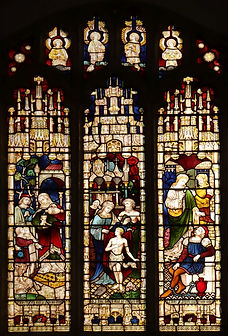
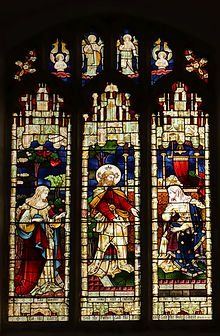
At the east end of the aisle is another section of four mediaeval stalls, two of them with misericords, either from the rood screen or possibly the choir – the right-hand end looks as if it might have stood against a wall. The aisle has four stained glass windows, all by Clayton & Bell. Starting from the east, they are “The Master is come” (1875): Acts of Mercy (1878): the Annunciation, the Presentation in the Temple and the Flight to Egypt (1878): and in the west window the Last Supper (1922).


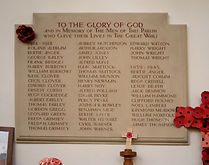

On the south wall there is the memorial to the dead of the village in both World Wars, with a ceramic poppy in the corner, one of the 880,000 planted in the moat of the Tower of London in 2018 to commemorate the centenary of the Armistice. The list of the casualties of the Great War incorporates a few men from Leavenheath, which was administratively part of Stoke at the time; and from Polstead, as the boundary between the villages then ran down the middle of Polstead Street in Stoke. One casualty, Harry Noy, died of his wounds at home after the Armistice, and is buried in the churchyard with the standard Commonwealth War Graves’ stone. It may be noted that two other WWI veterans are buried here - the Rev.Horace Wilkinson, Vicar from 1899 to 1914, who served as chaplain in the Royal Navy from 1914 to 1919, and was custodian of the mummified head of Oliver Cromwell; and Brigadier Henry Wiley, Military Cross, of the Royal Dragoon Guards. Over the memorial is the laid-up standard of the Stoke branch of the Royal British Legion.
The royal arms over the south door are placed there in accordance with the Act of Queen Elizabeth I of 1558 that all churches must display the arms: they were restored in 2004. They are the blazon used between 1714, the accession of King George I, Elector of Hanover, and 31st December 1800, in the reign of King George III. The arms of the King of France (three fleurs de lis) were then deleted, a mere 378 years after the infant Henry VI of England was obliged to cede the French throne, which he had inherited through his mother Catherine de Valois, to his uncle Charles VII. It is sometimes suggested that its deletion was a condition of the Peace of Amiens on 25th March 1802, but that is not the case. These arms are a rather amusing example of avoiding “unnecessary expenditure” with GR replaced by VR for Queen Victoria: under the Salic Law she, a woman, was not permitted to inherit Hanover, and the blazon she used was the one we are familiar with today.

The arms show what are to us the customary three lions of England, (technically “leopards”), the lion rampant of Scotland, and the harp of Ireland, but the fourth quarter is the blazon of the Georges as Electors. It shows the two golden lions of Brunswick, the blue lion of Luneburg, and the white horse of Hanover, and in the middle an “inescutcheon” of the crown of Charlemagne, to indicate that the Elector was ex-officio Treasurer of the Holy Roman Empire. The original electors were the seven men nominally supposed in an open meeting of every aristocrat in Germany to elect the Emperor of the Holy Roman Empire of the German Nation – the Archbishops of Cologne, Mainz and Trier; and the King of Bohemia, the Count Palatine of the Rhine, the Duke of Saxony, and the Margrave of Brandenburg., to which others including the Elector of Hanover were added over the centuries. By 1800 the title had long been hereditary in the Hapsburg Emperors of Austria.

Vicars of St. Marys